
Battery Energy Storage (BESS)
Store clean energy. Deliver it when it matters.
What Is a BESS?
A battery energy storage system stores electricity when it is plentiful and delivers it when it is needed.
A BESS plant combines batteries, power conversion, controls and a grid connection into one system. It can sit alongside a solar or wind plant, at an industrial site, or on its own, connected directly to the grid.
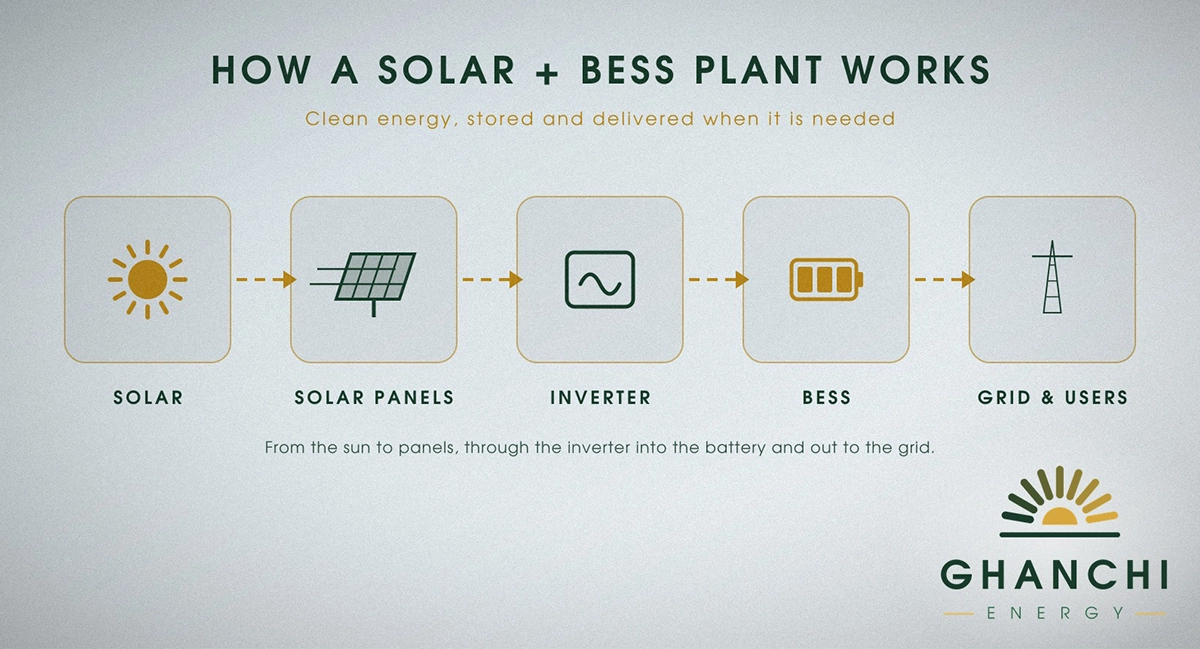
Where BESS Adds Value
Energy Shifting
Store midday solar output and supply it in the evening peak.
Peak Demand Management
Reduce the highest demand charges for commercial and industrial users.
Backup and Resilience
Keep critical loads running during grid outages.
Renewable Firming
Smooth the variability of solar and wind output.
Grid Support
Help stabilise voltage and frequency, where the grid code allows.
Less Diesel
Reduce generator running hours at sites that rely on diesel.
Inside a BESS Plant
- Battery modules and racks: the cells that store the energy, housed in containers or buildings
- Power conversion system: inverters between DC battery power and AC grid power
- Battery management system: monitors every module for voltage, temperature and safety limits
- Plant controller: decides when to charge and discharge, and talks to the grid operator
- Thermal management: cooling and heating to protect performance and life
- Fire detection and suppression: detection, suppression, ventilation and separation distances
- Transformer and grid connection: switchgear, protection and metering
Configurations
- Stand-alone BESS connected directly to the grid
- Solar plus storage, AC-coupled: easy to add to an existing plant
- Solar plus storage, DC-coupled: shares inverters with the solar array
- Behind-the-meter storage for factories, mines and campuses
- Hybrid plants combining solar, wind and storage
- Microgrids for remote sites
How We Size a System
1
Define the goal
Energy shifting, peak shaving, backup, firming or grid services.
2
Analyse the profile
Load, solar and wind output, tariffs and grid constraints.
3
Select power and duration
Power in MW sets how fast the system delivers. Energy in MWh sets how long.
4
Model life and economics
Degradation, temperature, cycling and project economics.
From Concept to Operation
- Feasibility: site, grid and load review, with an outline design and cost
- Design and technology selection: battery chemistry, layout, electrical and safety design
- Procurement: supplier qualification, factory checks, shipping to site
- Construction and installation: civil works, enclosures, electrical installation and grid connection
- Commissioning and handover: tests, grid compliance, training and operation support as agreed
Safety and Quality
- Reputable suppliers and tested battery systems
- Enclosure and layout designed for safe spacing
- Fire detection, suppression, ventilation and separation
- Thermal management and continuous monitoring
- Commissioning tests and clear operating procedures
- Emergency plans prepared with the site team
- All in line with recognised standards and local requirements
Ways to Work With Us
EPC
We design, procure and build the BESS. You fund and own it.
EPC+F
We build it and arrange the financing, repaid over time.
Development + EPC
We develop and build solar-plus-storage for your own load or for sale.
Partnership and Investment
We can invest alongside you in suitable storage projects.
Frequently Asked Questions
What is the difference between MW and MWh?
MW is power, how fast the battery can charge or discharge. MWh is energy, how much it can store. Duration is MWh divided by MW.
How long does a battery last?
It depends on the chemistry, number of cycles, temperature and operation. Warranties and degradation are agreed and modelled for each project.
Can storage be added to an existing solar plant?
Often yes, usually AC-coupled, subject to grid and site assessment.
Is a BESS safe?
Safety is designed in from the start, with certified equipment, fire protection, thermal management and monitoring.